


It is here that Makenzi, a taxi driver, saw a burning bush in the normal course of an airport transfer, or whatever his moment of conversion to fanaticism was. And it is here that he gathered followers from across the country – Nairobi, Kisumu, Kakamega and so on – and put them on route C103, the veritable Road to Damnation, with the final destination being Shakahola, a place no one had heard of until emaciated ghouls, more like walking corpses than human beings, started stumbling out of the thicket.
They were driven in a van or tuk tuks the 80 kilometres on what for some was the final journey which at some points was, at least, interesting and scenic, and at others, alien. At one point, the road cuts through the outer reaches of Arabuko Sokoke Forest on the left with the lazy coils of the Sabaki River on the right, the mighty Athi River in its old phase, before it slithers into the Indian Ocean. There is an almost hauntingly ominous poetry to the names of the stops along the way: Jilore, Sosoni, Kakomeni, Baolala, Langobaya, Timboni, Chakama, Zowerani and then, Shakahola.
The natural environment and the culture may come as a shock too for upcountry folk from the cities and places such as Mt Kenya and Western. It is hot and dry here, very hot, not wet and lush like back home. There aren’t too many people; it is mainly mile after mile of solitude. In the wilderness, tens of kilometres from Malindi and in the middle of the back of beyond, they must have been amused to see signboards for ‘beachfront plots’ on sale. They must also have seen women and children on the road shouting ‘Ciao’ to passing tour vans and signaling with thumbs up. The C103 is Kenya’s longest begging corridor.
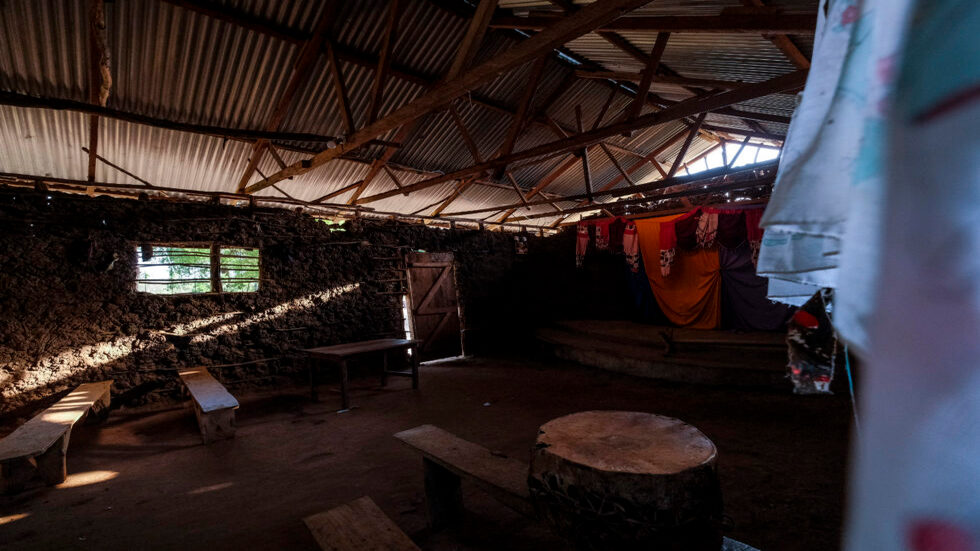
Shakahola kwa Makenzi, the so-called New Eden that Paul Makenzi had set up for his followers is nothing like its Biblical namesake: it is a harsh, dry, snake and scorpion-infested dump. A year after being abandoned, the mud cabins, built with technology from 2.5 million years ago, the Stone Age, resemble brown maize cobs with some seeds missing. They are built with rough, unhewn timber posts driven into the ground and branches horizontally attached to them with twine. The walls are brown rugged mud, neat squares of which have collapsed. The roof is the same branch-and-twine job with grass thatch. This is the kind of dwelling a hunter gatherer would perhaps feel at home in.
After a year of neglect and being poked by police, many have started to lean.
When the sect first came, members sold their belongings and bought construction material. Nearly all of them bought iron sheets for roofing. But they were warned that iron sheets had a code that could be used to identify them by the authorities and given “chapa ya mnyama” (mark of the beast)”. They removed the roofs and the cult leadership sold the iron sheets.
The path from the main road to the settlement is paved with hot, sunbaked rocks and sharp tree stumps, known to tour drivers as “visingi ”. It is hedged by sharp thorns that can rip flesh off your body and towering Mtola trees which, like the baobab, truly belong in nightmares and horror movies: they have no leaves and appear upside down, with the roots in the air and branches underground.
Anything between 1,500 and 3,000 souls lived in this huge religious forest colony, hidden from the outside world – and each other. When a new member arrived, they were ordered to burn all their identification documents, academic and other certificates and their mobile phones. They were also required to shave their hair and acquire new names. HALLELUYA, MTEULE, MZEE SMART.
Sect members followed Makenzi to the forest in 2019 after he declared that the time of converting souls and preaching was over. True believers, as was written in the Book of Maccabees, were to go to the wilderness and wait for the Second Coming of Christ, which was, allegedly, on hand.
Xxxxxxxxxxxxxxxxxxxxxxxx
Death pen 1: A little girl’s shoe in the bush
Crime Scene 126 is a three-room mud cabin, much in keeping with the Stone Age architecture of the settlement. It has an outside structure whose purpose is a mystery; it may have served as a kitchen, though there is a room with an earthen hearth in the main house.
At the back of what remains of the house, there is a curious profusion of food wrappings. Was this a store? A shop? Could this have been the shop of the famous Mugambi the merchant – the Mr Plug of the settlement – whose bizarrely fractured body was exhumed, dressed to the nines and still fat where most others were emaciated? A single, conspicuous article of clothing brings tears to the eyes and a lump to the throat: a red, Croc-type shoe with white decorations to the front, possibly worn by a three or four-year-old girl. In the mind’s eye, one can see a child’s soft heel at the back and cute little toes peeking out of the front. A structure of rough, flat stones forming the shape of a bench sits in front of the house which is hedged by a fence of vicious thorns common in the area and which makes the compound impenetrable to animals and humans alike. Near the bench was a discarded torch. Throughout the house and the compound are sisal ropes and strips-of-cloth restraints.
Early responders claimed this was no ordinary house; it was a holding pen for children who were being force-fasted. The stone bench was a guard station to ensure that the children stayed in and no one interfered in the process, they said. The early responders claimed that as many as 20 children would be locked up in the house at a time, without food or water and scream, cry and whimper themselves to death. This is a widespread allegation. Temperatures during the day can reach the high 30s, or hotter, inside the dwellings.
The claims are, of course, impossible to verify because ongoing criminal cases and police investigations.
Xxxxxxxxxxxxxxxxxxxxxxxxxxxxxxx
Death Pen 2: The agony of watching your own grave being dug
A year after security forces and villagers invaded Shakahola and drove the sect out, Crime Scene 128, other than the numbers written in blue on a tree branch, looks like any other ordinary thicket with dry clearings interspersed with thorn shrubs and sturdy trees. Scattered all over the ground, and some still tied to branches, are colourful strips of cloth. The area is bordered by a thorn fence, now much damaged and overgrown with the passage of time.
This, early responders said, was a fasting bay. Fearing discovery and rescue by security teams, who were circling the place and showing every sign of planning to move in, sect members fled their homes for isolated areas such as this, stripped naked and lay in the sun in an attempt to hasten their own demise. Disobedient older children, especially those who tried to flee but were too big to be locked up with the small children, were tied to trees in a forced fast, the responders said.
There is a graveyard just over the thorn fence. So it is possible that as they suffered in the sun, the young people could see graves being dug.
Xxxxxxxxxxxxxxxxxxxxxxxxxxxxxxx
STATION TIGO: THE ONLY HOUSE IN KENYA WITH A VIEW OF A MASS GRAVE
In the village of Tigo, there is a mud and thatch cabin unlike any other, though it looks like other dwellings in the forest settlement. Its front yard is a series of brown clay mounds and deep holes. When police invaded the settlement a year ago, this was just another house opening to a garden of maize, cowpeas, groundnuts, among others. But a strong smell and swarms of flies caught their attention. When the crops were cleared, they discovered the biggest mass grave so far with 65 bodies. In some of the older graves, bodies are pairs of a man and a woman, but this area was different. The newer graves had many bodies; one had 12, stacked on top of each other.
Some of the bodies were thin and emaciated, but a section contained remains of well-built, seemingly healthy and well-fed people but which bore fractures and other evidence of violence.
The house of Tigo is perhaps the only one in the world whose windows open to a view of a huge mass grave.
SALAMA THE STORY TELLER
Salama was scared out of her wits. She had been declared a “msaliti” (traitor) by sect leader or Mtumishi, Paul Makenzi. He ordered that she be shunned and excluded from all meetings and community activities. All information was to be withheld from her and she was not to be visited or allowed to visit anyone.
Her husband, too, was furious. She claims he is the one who reported her to top the sect bosses. “Mbona kashuka?(why backtrack?)” he fumed. She had broken the fast, the ultimate sacrilege. Word had come that it was time to go to Jesus. “Hakuna muda, tunaenda kwa yesu (time is up, we are going to see Jesus),” they were told. “Wakati wa chakula umeisha. Chakula sasa ni dhambi” (Time’s up for eating. Now food is sin).
Mother of five Salama, 30, would not be alive and talking in secret to journalists in a Malindi hotel courtyard. Fellow followers of Good Life cult are either dead, in jail or on the run. The whereabouts of her husband and fellow cult member, Alex Kahindi aka MTEULE, are supposedly unknown, although village elders believe he is on the run, possibly even in Malindi.
The State has taken her children into care: Amani, 9, Mariam, 8, Pascal, 5, Eliza, 3 and Esther, 1 ½ .
When they were newly settled in Shakahola, her husband used to go out and work as a plumber. They lived on a two-acre piece of land and farmed peacefully, co-existing with wild animals, which never attacked them or destroyed their crops. Occasionally, a child would shout: “Mama nyoka huyu yuapita! (Mum, that is a snake passing)” Other than the “small thing” of one of the children being bitten by a snake, their lives were quiet, Saturday services in the bush chapel were normal and preachers would advise them to dig water pans to prepare for heavy rains that were coming, to plant food and to work their farms. Cult members traded with the local community and trekked to Sabaki river to fetch water.
However, the intended introduction of Huduma Namba announced by the government in 2019 changed everything. It was seen as a sign of the End Times. The number was declared a mark of the devil and all identification documents and certificates were collected and burnt. Her husband was forced to stop going to work.
In their third year in the forest, 2022, she claims that a white preacher came one Saturday with a message that marked the end of their idyllic life in the wilderness. He preached the message of fasting, saying, “There is no time, fast and go to heaven.” The mantra became: “Hakuna muda, tunaenda kwa yesu.” (Time is up, we are going to meet Jesus). This unverified claim, like all fantastic stories from Shakahola, is to be taken with spades of salt. Evidently, not everyone wanted to die: Members started fleeing.
She claimed the sect realised cult members were all going to flee and new orders came: “Hakuna kutembeleana, hata kuombana chumvi, hakuna kutoka, muda umeisha, kula ni dhambi.” (Keep to yourselves, no visiting each other, not even to borrow salt, you are not allowed to leave the forest, time is up, eating is sin.) At this point, the cult is said to have tightened security in the forest by forming an enforcement team. They kept villagers and herders from coming in and sect members from leaving.
Salama confesses she fasted for eight days and her children for four days. The wailing of her children begging for water broke her resolve.
“Mama tusaidie maji tunakufa (Mum, give us water, we are dying),” they cried.
Only Amani wanted to die and go to Jesus, she claims. The others were too young to understand what was going on. She breastfed her newborn daughter who was born in the forest only once, then withheld milk. The baby cried without pause the whole night. In the morning, she took a decision. “If Jesus wanted us to die, he was going to have to find another way,” she said. In February, she fled. Fortunately, she had chosen her land in the forest fortuitously, possibly because she was a native of Shakahola. Her home is a short distance from the cult settlement and she lived closest to the road.
Another woman had hidden her two children in Salama’s house and they all fled together. “When my mother saw me, she broke down and cried. I couldn’t speak, my throat was too dry. When we washed the children, they cried and scratched themselves, saying their skin was burning.”
Her story is received with skepticism in her village. Villagers are generally secretive but word is that she and her children were abducted and spirited out of the forest by locals. The State took her children into protection, but she is allowed to visit. She is a vagabond with no fixed abode and does not trust herself to go back to her mother’s house in Shakahola. Villagers think her husband is also “around”, perhaps even in Malindi town, lying low to avoid the police, perhaps the fog of suicidal beliefs still swirling around his head.