


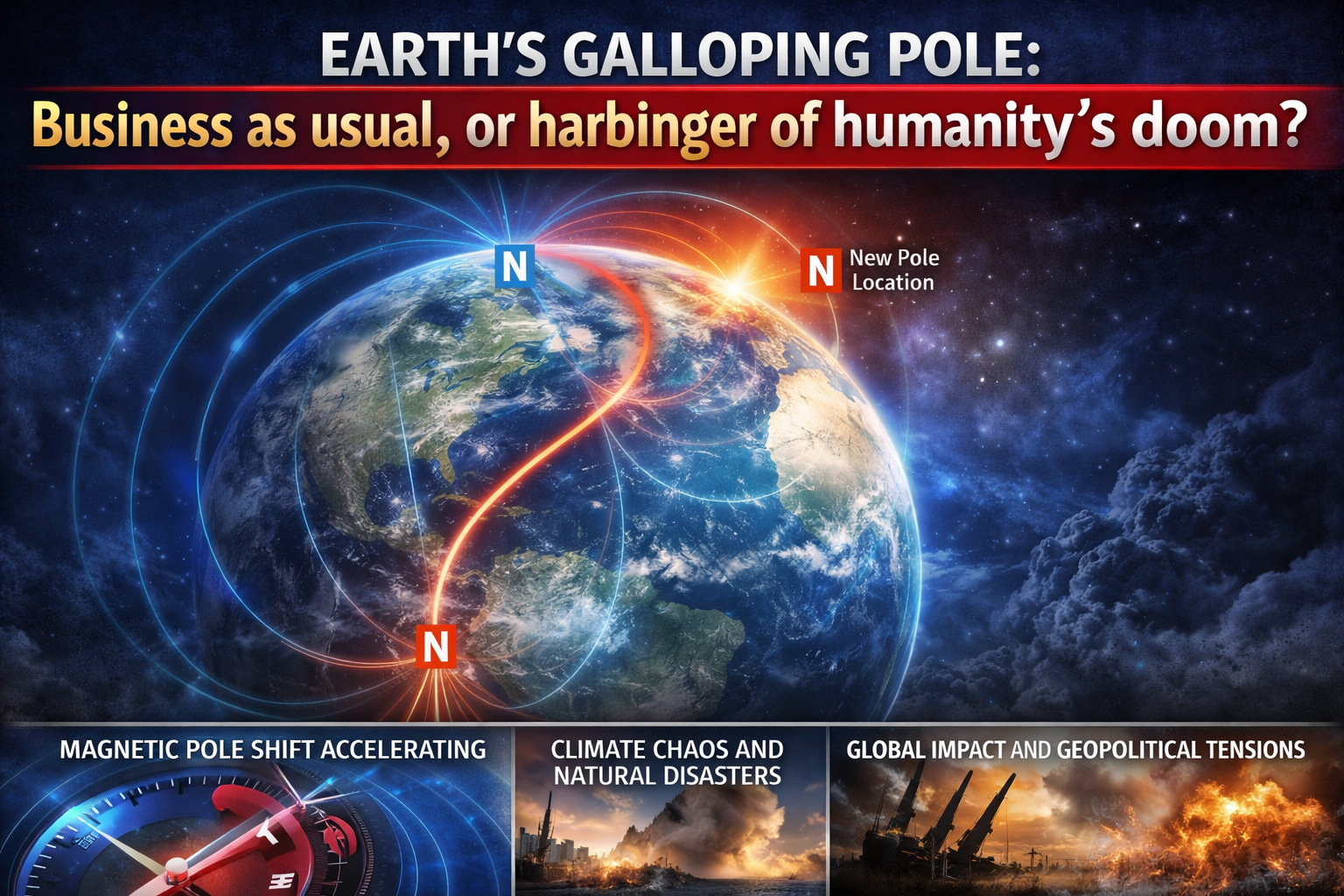
Geologists measure the world not in years, but in layers of rock. When they look at our planet’s ‘clock’, it – those layers – doesn’t tell a story of slow, steady progress; they paint a picture of “stops and starts.”
One of the most provocative ideas currently being discussed in the corridors of independent geophysics is the Earth Crust Displacement and Overturn (ECDO) theory. While it sounds like the plot of a disaster movie, it is a serious attempt to explain why Earth’s “skin” might occasionally slip, and what that means for the future of our civilization,
To understand ECDO, imagine the Earth as an orange. The center is solid, but it’s surrounded by a layer of hot, slushy white pith (the mantle). The peel on the outside is our crust—the ground we stand on.
The ECDO theory suggests that under certain conditions, the “pith” becomes so slippery and the “peel” becomes so unbalanced that the entire crust shifts as one piece. Imagine spinning that orange and having the peel slide 30 degrees in a matter of weeks. Suddenly, the land that used to be at the North Pole is now in the temperate zone, and a tropical jungle is shoved into the freezing Arctic.
But why would it slip? The theory hinges on the whole question of core instability. At the center of our planet is a spinning ball of liquid iron that creates our magnetic field. Proponents of ECDO argue that every few thousand years, this “engine” undergoes a violent hiccup. Secondly, our magnetic shield out in space is currently weakening—losing about 10-15% of its strength in the last century. The third clue is the wandering North. The Magnetic North Pole, which used to be relatively stable in Canada, is now “jaywalking” toward Siberia at speeds never recorded in human history (over 50km per year). And finally, is the trigger: Some theorists believe that as the magnetic field reaches a “tipping point,” it creates a massive torque (a twisting force) on the mantle. This “lubricates” the layer beneath the crust, allowing the entire surface of the planet to shift to find a new center of gravity.
So where is the evidence to support this interesting, if sobering, theory? Well, if this has happened before, shouldn’t there be scars? ECDO supporters point to several anomalies that mainstream science struggles to explain. The first, are the flash-frozen mammoths of Siberia, which have been found with undigested tropical grasses in their stomachs. This suggests a climate change so rapid that it didn’t just kill them—it “snap-froze” them in mid-meal. An ECDO shift would explain how a grassland could become an Arctic wasteland in days. The Great Sphinx in Egypt shows signs of vertical water erosion. This implies it was hit by thousands of years of heavy rain. If the crust shifted, Egypt might have once sat in a tropical belt before sliding into the desert we see today. Ancient controversial maps, like the Piri Reis map from the 1500s, appear to show the coastline of Antarctica without ice. If the crust had shifted, Antarctica might have been ice-free and inhabited just a few thousand years ago.
Mainstream science rejects ECDO as pseudoscience and modern day mysticism. Traditional geologists argue for plate tectonics, where continents move at the speed your fingernails grow (centimeters per year). They believe the North Pole moves because of slow wobbles in the Earth’s tilt, not because the crust is “slipping.” They attribute things like the frozen mammoths to localized weather catastrophes or slow-onset ice ages, rather than a global “reset.”
The academic consensus is that while the magnetic field is definitely weakening and the poles are moving, this will likely only result in a magnetic reversal (where North becomes South), affecting our satellites and power grids, but not causing the physical crust to move. If the academics are wrong and the ECDO theory brigade is correct, a “shift” is the mother of all planetary resets, and it could come at massive biodiversity cost. First, it will trigger mega tsunamis. As the crust moves, the oceans (which want to stay in place due to inertia, would wash over the continents in waves miles high). The friction of the crust sliding over the mantle would trigger every fault line and volcano on the planet simultaneously, resulting in massive volcanism. And the climate would be erased at an instant. Our current breadbaskets (like the US Midwest or Ukraine) could end up at the poles, while the ice caps melt rapidly as they slide toward the equator.
We are currently watching the “prelude” to what ECDO proponents call a shift: a racing magnetic pole and a thinning shield. Whether this ends in a minor technical glitch for our GPS systems or a physical “slippage” of the world as we know it remains the greatest debate in planetary science. The rocks tell us that the Earth changes, often violently, now we have to figure out if we are living through a quiet era or the eve of a great plate migration.
–By Mutuma Mathiu