


By Jay’z Oduor
If you found yourself in Kenya for the very first time, this is what you are likely to find; one, you are likely to run into a young person, and the young person will likely be unemployed.
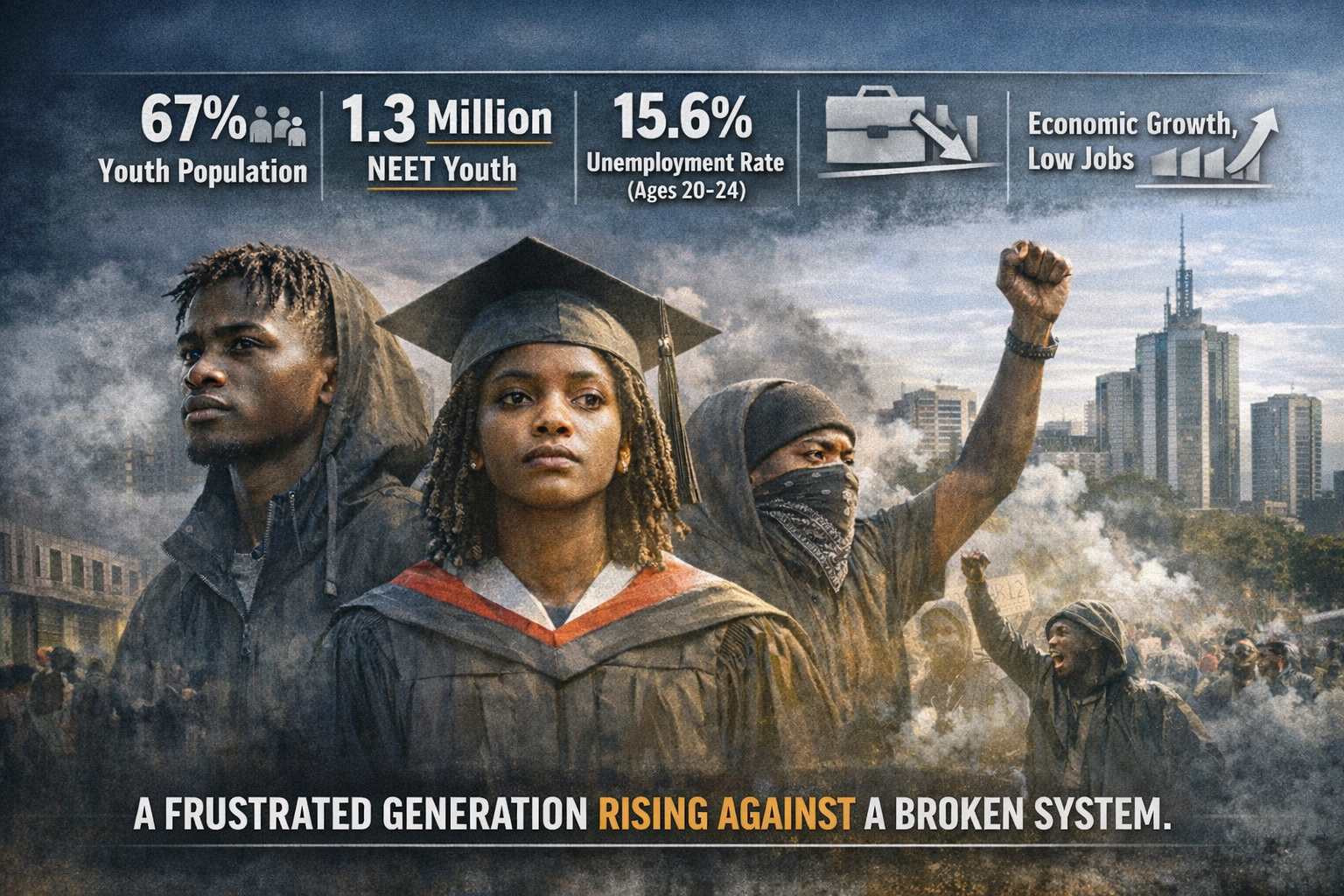
Data from the last census in 2019 and the latest quarterly labour statistics from the Kenya National Bureau of Statistics (KNBS) paints a grim picture for the youth who are not only the majority in the population but also the worst hit by the unemployment curse.
Census data shows that persons aged from 0 to 29 made up 67.6 percent of the Kenyan population at 32.13 million people out of a total population of 47.56 million at the time.
Persons aged between 20 and 29, a demographic representing new entrants to the labour force had a total of 8.2 million persons.
Kenya’s unemployment rate stood at 4.9 percent at the end of 2022 with the number of unemployed persons at 960,001 according to the State statistician.
Youth aged 20 to 24 had the highest levels of unemployment among all age cohorts at 15.6 percent excluding persons aged 15 to 19, most of whom are still in education and training.
Persons aged 25 to 29 had the second worst rate of unemployment at 5.9 percent, well above the national average of 4.9 percent.
The nominal count of unemployed persons among the two cohorts was 424,474 and 186,560 respectively which covers nearly three quarters of all unemployed persons.
The youthful cohorts also have the lowest levels of participation in work with their employment to population ratios at just 48.3 percent for persons aged 20 to 24 and 72.8 percent for persons aged 25 to 29.
The rate of persons deemed to be long-term unemployed also has a high incidence among the pair at 9.9 percent and 4.3 percent respectively.
Moreover, the number of 20 to 29 years olds not either in education, employment or training is also alarming, emphasizing the tragedy of unemployment among the youth.
The number of youths not in education, employment or training, a term dubbed NEET by KNBS was 1.3 million or 27.5 percent for persons aged between 20 and 24 and 991,162 or 24.1 percent for persons aged 25 to 29.
Incidentally, Kenya’s youthful population is among the most learned of previous generations, having been the first beneficiaries of free primary and secondary education, initiated by the late President Mwai Kibaki.
Despite their high intellectual capacity and their existence in an economy growing at an average of five percent, jobs have been hard to come by as the economy seemingly struggles to churn out new opportunities.
It is the very same demographic, frustrated and feeling neglected that quietly sowed the seeds of a revolution that would blow up in the faces of the current administration in their botched attempt to escalate domestic taxes.
The now famous or infamous Finance Bill, 2024, depending on the side of the coin flipped, was toppled largely by an uprising tailored by Kenya’s youth who have since been referred to as GenZs.
Ken Gichinga, the Chief Economist at Mentoria Economics states that the government has struggled to channel the youth dividend to its favour.
The failure has since bred discord with the cracks following through during the countrywide anti-government protests which began in June 2024 with the rejection of new tax measures.
“For a long-time, we spoke about the demographic dividend being big for Kenya with the median age at 19. The youth today are the products of free primary education and well educated unlike in the past. They are better placed to put two and two together, are better at articulating their issues whilst technology has played a big role in unifying the group,” he observes.
Estimates suggest that nearly a million young persons are coming out of tertiary education institutions every year and barely find job opportunities especially in the formal sector.
In 2024, only one of every 10 new jobs was in a formal setting while total new jobs created were the lowest since before the pandemic, signalling a drought in hiring by firms even as the economy grew by nearly five percent according to additional KNBS data.
The informal sector has increasingly become the life saver for jobs creation, but the sector made up mostly of small and medium enterprises (MSMEs) has not churned out high quality jobs amid a more educated population raising the stakes for further suffrage of the youth through underemployment.
Employers have attempted to find reasons for the runaway youth unemployment and have cited a gaping skills gap.
Even so, the economy has struggled to churn out as few as 100,000 new formal jobs in a year showing a bigger worrying picture.
The structure of the economy which favours high growth, but low jobs is partly to blame according to Gichinga.
“The configuration of the economy is not pro-jobs. There is still a high preference for capital intensive sectors of the economy where a lot of money is chasing very capital-intensive projects resulting in high profits but require very few staff.”