


In the Sudanese town of El Fasher, Amina clutches her infant daughter to her chest, weaving through the ruins of what was once a bustling market.
It was August 2024, and the siege had dragged on for months.
Gunfire echoed in the distance as Rapid Support Forces (RSF) clashed with the Sudanese Armed Forces (SAF).
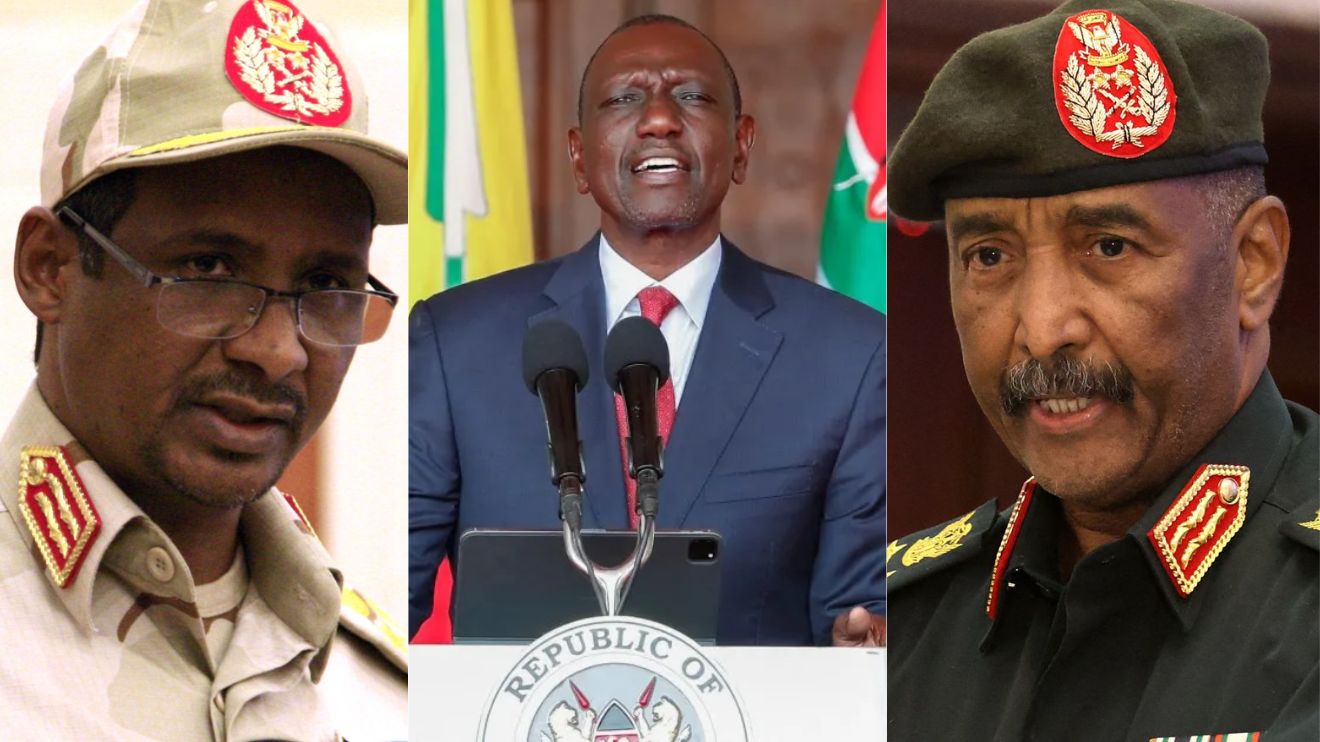
Amina’s husband had vanished months ago, swept up in the chaos of a war that began in April 2023 as a power struggle between two generals: Abdel Fattah al-Burhan of the SAF and Mohamed Hamdan Dagalo, known as Hemedti, of the RSF.
But this was no mere internal feud. Foreign hands pulled the strings, turning Sudan’s agony into a global chess game.
And among those hands was Kenya’s, once a beacon of peace in East Africa, now accused of fanning the flames.
Amina remembered the early days, when protests against military rule in 2019 had promised a democratic dawn.
Instead, the 2021 coup shattered it, and by 2023, Burhan and Hemedti’s rivalry exploded into full-scale war.
Firepower wasn’t homegrown
The RSF, rooted in Darfur’s Janjaweed militias infamous for the 2003 genocide, rampaged through Khartoum and beyond. But their firepower wasn’t homegrown.
The United Arab Emirates (UAE), eyeing Sudan’s gold mines and Red Sea ports, funnelled weapons, drones, and cash to the RSF through shadowy networks in Chad, Libya, Eritrea and Kenya.
Colombian mercenaries, hired by Abu Dhabi, fought alongside them, their boots staining Sudanese soil with foreign blood.
On the other side, Egypt and Iran backed the SAF, driven by fears over Nile water shares and strategic farmland.
Saudi Arabia, rivalling the UAE’s influence, poured support into Burhan’s forces, while Russia and China circled Port Sudan, hungry for naval bases that could reshape Red Sea dominance.
Then came Pakistan’s bold entry with a $1.5 billion arms deal inked with the SAF, supplying fighter jets, drones, and air defence systems, likely bankrolled by Riyadh.
Analysts whispered of a quid pro quo: access to Port Sudan for Moscow, tolerated by a silent Washington, as the U.S. outsourced its interests to avoid direct entanglement amid bigger rivalries with China.
Deeper into a proxy quagmire
Turkey, deepening ties with Islamabad, added another layer, bolstering defences that locked Sudan deeper into a proxy quagmire.
Eritrea and Libyan factions played their parts too, smuggling arms and fighters, turning the conflict into Africa’s newest arena for geopolitical jostling.
Kenya’s role stung the deepest for many Sudanese like Amina, whose family had fled south toward the border.
Nairobi, historically a peacemaker, hosting the 2005 Comprehensive Peace Agreement that birthed South Sudan, now stood accused of betrayal.
In February 2025, Kenya welcomed RSF leaders, including Hemedti’s brother Abdul Rahim Hamdan Dagalo, to Nairobi’s Kenyatta International Convention Centre (KICC).
There, they plotted a parallel “Government of Peace and Unity,” a move Khartoum decried as a violation of sovereignty.
Bellingcat investigations revealed Kenyan-linked weapons crates in Sudan, funnelled to the RSF, raising questions about Nairobi’s neutrality.
Sudan repeatedly accused Kenya of active support for the paramilitaries, warnings that escalated to threats of severed ties.
Kenyan officials, like Government Spokesman Isaac Mwaura, insisted their involvement was purely for peacebuilding and humanitarian aid, pointing to pledges like $1 million for Sudanese refugees.
“Good neighbour” reputation
Yet, critics saw hypocrisy in Kenya’s hosting one of the warring factions while claiming to heal the wounded. For Kenya, the stakes were economic and diplomatic prestige in the African Union (AU) and IGAD, but at the cost of its “good neighbour” reputation.
What was at stake extended far beyond Sudan’s borders.
The Red Sea corridor, vital for global trade through the Suez Canal, hung in the balance as a chokepoint where Russia’s potential naval base could challenge U.S. dominance, while China’s Djibouti outpost loomed nearby.
Sudan’s untapped gold and minerals fueled the war machines, with RSF smuggling networks enriching foreign patrons, with Kenyan top leadership being linked to sharing the spoils as regional spillover threatened risking wider instability.
For the great powers, it was a low-cost proxy war, testing alliances without boots on the ground. But for the Sudanese, it meant famine in 17 regions, where families like Amina’s ate grass to survive.
The human toll was a nightmare etched in numbers and nightmares. Over 40,000 to 150,000 dead since 2023, with recent RSF attacks in Darfur claiming 89 lives in just 10 days.
More than 12 million people have been displaced, making Sudan the world’s largest humanitarian crisis, with refugees swelling neighbours’ burdens.
Cholera ravaged, with 60,000 cases and 1,600 deaths by May 2025.
Killing dozens weekly
Over 700,000 children face acute malnutrition, and 33 million need aid amid the worst famine in 40 years.
Women have endured unspeakable rapes, communities shattered by massacres, and aid workers targeted, hindering relief.
In camps like Abu Shouk, shells rain down, killing dozens weekly.
Is the world doing enough? Amina, now in a makeshift camp near the Chad border, wonders as she queues for meagre rations.
The UN Security Council has condemned external interference and urged ceasefires, but words rang hollow.
US-led mediators have expressed “dismay” at the crisis, pushing for aid access alongside Saudi Arabia and the UAE, ironically, the same powers arming warring sides.
The 2025 Humanitarian Response Plan, seeking $4.2 billion for 21 million vulnerable people, was only 23-28% funded.
AU and IGAD talks faltered, with failed truces and underfunded appeals.
NGOs like the IRC and Oxfam have decried the “failing global response,” warning of regional catastrophe.
Critics argue the world has prioritised Ukraine and Gaza, leaving Sudan to fester in neglect, its people pawns in a game of resources and power.
As night fell, Amina whispers to her child, “One day, the shadows will lift.” But with foreign meddling unchecked and aid trickling in, that day seems a distant dream.