


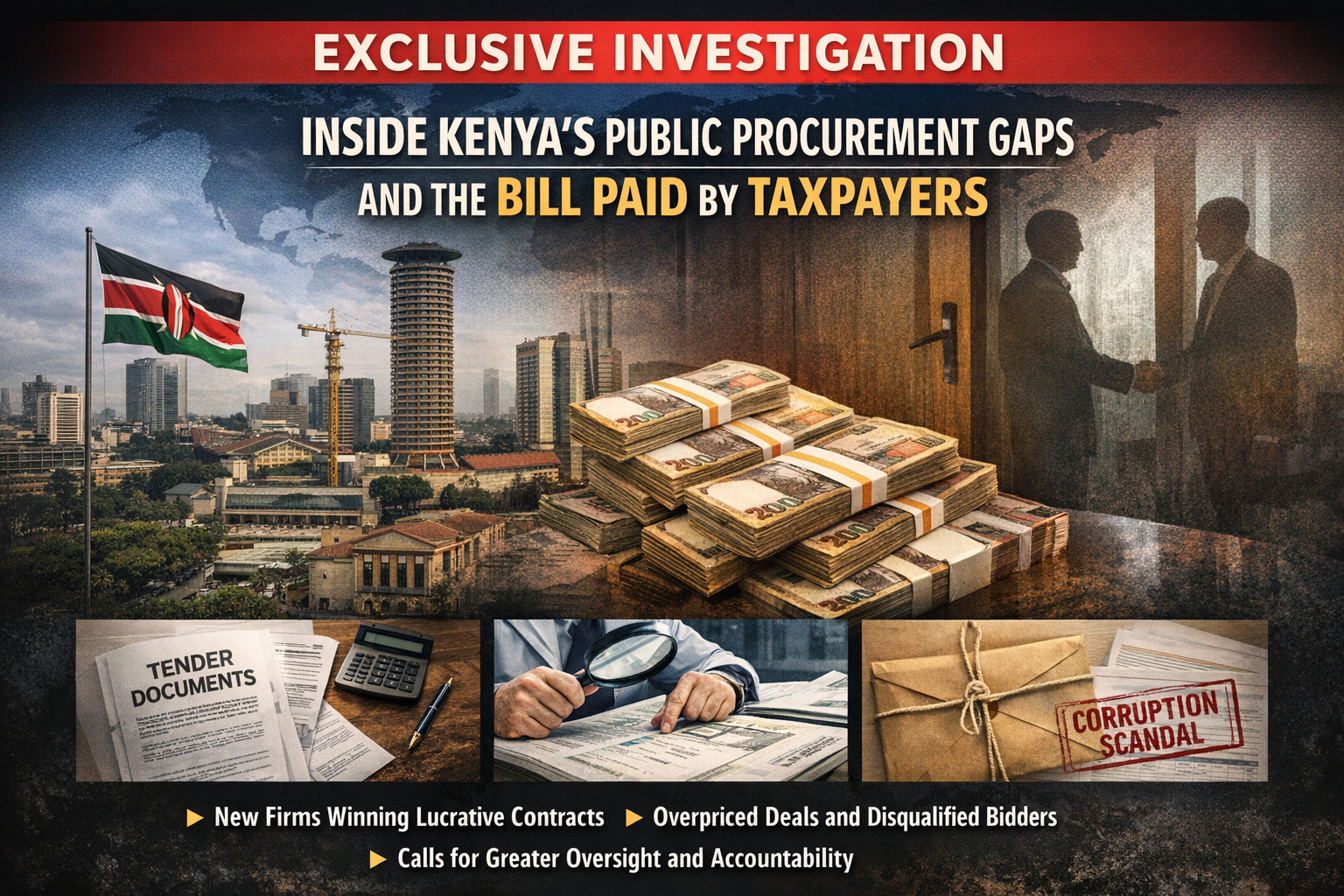
Public procurement remains one of the largest drivers of government expenditure across Africa. In Kenya, procurement spending accounts for a significant share of the national budget, touching critical sectors such as infrastructure, healthcare, energy, and education. While procurement laws are designed to ensure transparency, competitiveness, and value for money, recurring audit findings suggest persistent weaknesses in enforcement and oversight.
This investigation examines how procurement loopholes, weak disclosure practices, and limited accountability mechanisms continue to expose public funds to misuse. Drawing from company registry data, procurement records, audit reports, and expert interviews, it highlights systemic risks rather than isolated failures—and why these risks matter to investors, development partners, and taxpayers.
The Scale of Public Procurement in Kenya
According to official budgetary allocations, Kenya spends hundreds of billions of shillings annually through public procurement. These funds are distributed across ministries, state corporations, county governments, and special purpose agencies.
Procurement is governed primarily by the Public Procurement and Asset Disposal Act (PPADA), which sets out clear requirements for:
-
Competitive tendering
-
Disclosure of tender opportunities
-
Evaluation based on technical and financial criteria
-
Documentation of delivery and payments
Despite this framework, repeated reports by the Auditor-General and parliamentary committees have pointed to:
-
Non-competitive awards
-
Single-sourcing without adequate justification
-
Payments for incomplete or delayed works
-
Limited consequences for violations
What the Investigation Found
An analysis of selected procurement cases over recent financial years reveals recurring patterns that raise red flags for governance and fiscal discipline.
1. Newly Registered Companies Winning Major Tenders
In several instances, companies incorporated only weeks or months before tender awards went on to secure contracts worth hundreds of millions—or billions—of shillings.
While the law does not prohibit new firms from bidding, procurement experts note that:
-
Lack of operational history makes due diligence difficult
-
Financial capacity and technical experience are harder to verify
-
Risk of front companies or proxy ownership increases
Company registry records reviewed during this investigation show overlapping directorships across multiple firms that have won similar tenders from different government entities, sometimes within the same financial year.
2. Limited Competition and Disqualified Bids
Tender documents examined show a trend where:
-
Multiple bidders are disqualified at the technical evaluation stage
-
Remaining bids face minimal price competition
-
Justifications for disqualification are often vague or inconsistently applied
Procurement specialists interviewed noted that excessive reliance on technical disqualifications can be used to eliminate legitimate competitors, undermining the principle of value for money.
3. Pricing Above Market Rates
A comparison of contract pricing against prevailing market rates for similar goods and services revealed significant variances.
In some cases:
-
Contract prices exceeded market benchmarks by over 30 percent
-
Cost breakdowns were missing or insufficiently detailed
-
Variation orders were introduced shortly after contract signing
Economists warn that inflated pricing not only drains public resources but also distorts markets by crowding out efficient private sector players.
Impact on Businesses and the Economy
Small and Medium Enterprises (SMEs)
Local manufacturers and service providers interviewed reported difficulty accessing government tenders despite meeting eligibility criteria. Several cited:
-
Short tender advertising periods
-
Complex documentation requirements
-
Perceived favoritism toward politically connected firms
SMEs are critical to job creation and industrial growth. Exclusion from public procurement limits their ability to scale and compete regionally.
Investor Confidence and Development Financing
Kenya positions itself as East Africa’s business and investment hub. However, procurement governance remains a key concern for:
-
Multilateral lenders
-
Foreign direct investors
-
Development partners financing public projects
Weak procurement controls increase project risk, delay implementation, and raise the cost of capital.
Oversight and Accountability Challenges
Audit and Parliamentary Review
While audit reports regularly flag procurement irregularities, follow-up action remains inconsistent. Investigations are often:
-
Delayed
-
Limited in scope
-
Concluded without recoveries or prosecutions
Governance analysts point to capacity constraints and political interference as major obstacles.
Enforcement Gaps
Kenya has multiple oversight institutions, including:
-
The Public Procurement Regulatory Authority (PPRA)
-
The Auditor-General
-
Parliamentary committees
-
Anti-corruption agencies
However, overlapping mandates and slow coordination reduce their effectiveness. Sanctions against accounting officers and suppliers are rare relative to the scale of losses identified.
Responses from Public Institutions
Agencies contacted for comment generally maintained that procurement processes followed legal requirements. Some cited confidentiality clauses, while others referred inquiries to internal audit units.
In several cases, suppliers named in procurement records did not respond to requests for comment by the time of publication.
Why This Matters Regionally
Kenya’s procurement practices are closely watched across East Africa due to:
-
Regional infrastructure projects
-
Cross-border supply chains
-
Shared development financing
Procurement failures in one country can affect regional competitiveness, raise borrowing costs, and undermine integration efforts under frameworks such as the East African Community (EAC).
The Way Forward
Governance experts and policy analysts interviewed proposed several reforms:
-
Mandatory public disclosure of beneficial ownership for all bidders
-
Stronger enforcement of blacklisting provisions
-
Digitization of procurement records with real-time public access
-
Clear penalties for accounting officers who approve irregular payments
Transparency, they argue, is not only an anti-corruption measure but also a foundation for sustainable economic growth.
Conclusion
Kenya’s procurement challenges are not unique, but their economic impact is significant. As public spending expands to meet development goals, weaknesses in procurement systems risk undermining fiscal stability, private sector confidence, and public trust.
This investigation underscores a critical reality for African and global business audiences alike: procurement governance is not a technical issue—it is a core determinant of economic performance.