


Malindi sits on Kenya’s rump like a dimple, perhaps even a pimple. Known for its colourful association with the Italian mafia, ancient history, ruins and Swahili culture, it is a beautiful town that adds to the country’s broad appeal. But it is not a terribly important or wealthy place, just a nice holiday destination where Italians seem to be in charge.
It is here that Makenzi, a taxi driver, saw a burning bush in the normal course of an airport transfer, or whatever his moment of conversion to fanaticism was. And it is here that he gathered followers from across the country – Nairobi, Kisumu, Kakamega and so on – and put them on route C103, the veritable Road to Damnation, with the final destination being Shakahola, a place no one had heard of until emaciated ghouls, more like walking corpses than human beings, started stumbling out of the thicket.
Doomed believers were driven in a van or tuk tuks the 80 kilometres on what for some was the final journey which at some points was, at least, interesting and scenic, and at others, alien. At one point, the road cuts through the outer reaches of Arabuko Sokoke Forest on the left and the lazy coils of the Sabaki River, the mighty Athi River in its old phase, on the right before it slithers into the Indian Ocean.
There is an almost hauntingly ominous poetry to the local names of the stops along the way: Jilore, Sosoni, Kakomeni, Baolala, Langobaya, Timboni, Chakama, Zowerani and then, Shakahola.
The natural environment and the culture must have come as a shock too for city and upcountry folk from places such as Mt Kenya and Western. It is hot and dry here, very hot, not wet and lush like back home. There aren’t too many people; it is mainly mile after mile of solitude. In the wilderness, tens of kilometres from Malindi and in the middle of the back of beyond, they must have been amused to see signboards for ‘beachfront plots’ for sale. They must also have seen women and children on the road shouting ‘Ciao’ to passing tourist vans and signaling with thumbs up. The C103 is Kenya’s longest begging corridor.
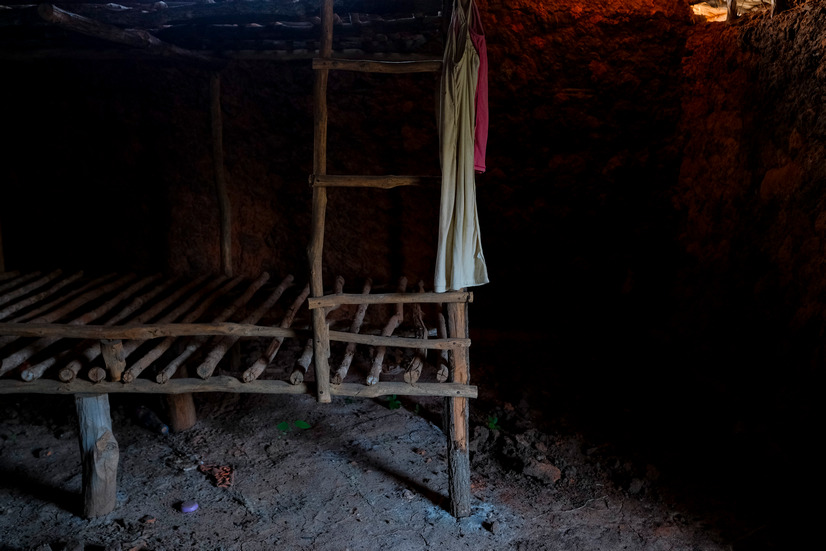
Shakahola kwa Makenzie , the so-called New Eden that Paul Makenzie had set up for his followers is nothing like its Biblical namesake: it is a harsh, dry, snake and scorpion-infested dump. A year after being abandoned, the mud cabins, built with technology from 2.5 million years ago, the Stone Age, resemble brown maize cobs with some seeds missing. They are built with rough, unhewn timber posts driven into the ground and branches horizontally attached to them with twine. The walls are brown rugged mud, neat squares of which have collapsed. The roof is the same branch-and-twine job with grass thatch. This is the kind of dwelling a hunter gatherer would perhaps feel at home in.
After a year of neglect and being poked by police, many have started to lean.
When the sect first came, members sold their belongings and bought construction material. Nearly all of them bought iron sheets for roofing. But they were warned that iron sheets had a code that could be used to identify them by the authorities and be given “chapa ya mnyama” (mark of the beast)”. They removed the roofs and the cult leadership sold the iron sheets.
The path from the main road to the settlement is paved with hot, sunbaked rocks and sharp tree stumps, known to tour drivers as “visiki ”. It is hedged by sharp thorns that can rip flesh off your body and towering Mtola trees which, like the baobab, truly belong in nightmares and horror movies: they have no leaves and appear upside down, with the roots in the air and branches underground.
Anything between 1,500 and 3,000 souls lived in this huge religious forest colony, hidden from the outside world – and each other. When a new member arrived, they were ordered to burn all their identification documents, academic and other certificates and their mobile phones. They were also required to shave their hair and acquire new names. HALLELUYA, MTEULA, MZEE SMART. Believers lost their identity and sense of individuality
Sect members followed Makenzi to the forest in 2019 after he declared that the time of converting souls and preaching was over. True believers, as was written in the Book of Maccabees, were to go to the wilderness and wait for the Second Coming of Christ, which was, allegedly, on hand.