



By Bonface Orucho
The first warning sign was a headache that would not go away. For Amina Roba, a mother of three in Kargi, a remote village in Marsabit County, it began as a dull ache behind the eyes. She was seven months pregnant. The nearest health centre was 18 kilometres away. Transport meant hiring a motorbike she could not afford. She told herself it was just fatigue.
Two days later, her feet were swollen. By the time she reached the county referral hospital, her blood pressure had spiked dangerously. The baby survived but she did not.
Stories like Amina’s are common in a country where pregnancy, despite policy gains, remains one of the most persistent public health risks.
According to the World Health Organization (WHO), Kenya records an estimated 355 maternal deaths per 100,000 live births, far above the global target of fewer than 70 deaths by 2030.
Across Africa, the crisis is deeper. UNICEF estimates the continent accounts for about 70% of global maternal deaths, with a regional ratio of roughly 454 deaths per 100,000 live births.
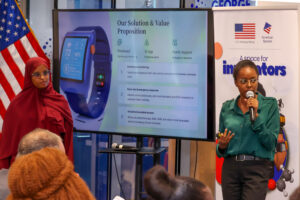
Medibora team members Jael Wainaina (holding the microphone) and Fardosa Mohamed make presentation about their project during the hackathon’s awarding ceremony. Photo courtesy: Medibora
Many of those deaths happen not inside hospitals, but in the villages hours before help arrives. It is this space, between symptom and care, that a group of Kenyan students are trying to close.
When the Stars of Innovation US-Kenya AI Challenge announced its finalists, the MediBora team had already been thinking about mothers like Amina for weeks. They had met as strangers at a hackathon, drawn together by a shared frustration of pregnant women slipping through the last mile of healthcare.
“As we started talking, we realised we all came from different backgrounds but shared an interest in healthcare, and that maternal health was a problem that needed to be handled with seriousness,” said Jael Wainaina, the team’s data scientist.
Wainaina and her colleagues, who include developers, a biomedical engineer, business students and data specialists quickly discovered that the problem was not simply medical. It was structural.
According to the World Bank, delays in deciding to seek care contribute to roughly one-third of maternal deaths in Kenya. About 70% of pregnant women live in rural areas, where distance, cost and transport gaps slow emergency referrals. Clinics may exist on paper, but geography, poverty and information gaps stretch the time between danger and response.
“We realised there is a big gap because many mothers skip clinic visits, so hospitals are not able to track their progress or detect early warning signs while they are at home,” Wainaina said.
From that gap, MediBora was born. The platform combines AI-assisted risk logic with communication channels already embedded in Kenyan households. Rather than relying only on smartphone apps, MediBora integrates SMS, USSD and voice prompts tools that work even on basic feature phones.
That decision reflects reality. According to the Communications Authority of Kenya (CAK), Kenya had about 75 million mobile connections by late 2025, representing more than 140% penetration. SMS access reaches households that have never downloaded an app.
Through routine check-ins, MediBora asks expectant mothers to report symptoms such as persistent headaches, swelling, dizziness or reduced foetal movement, which are early warning signs clinicians already recognise in conditions like pre-eclampsia and haemorrhage. Responses feed into a rules-based risk scoring system built from established clinical guidelines.
“We are very careful about this,” Wainaina said. “At this stage, we have not tested on patients. It is still a prototype, and we are working on approvals so that validation can happen ethically and safely.”
If symptoms indicate elevated risk, the system flags the case on a clinician’s dashboard. Doctors or nurses can then call the mother in early or initiate a referral before the situation becomes critical.
“There is a patient dashboard and a doctor’s dashboard,” explained Fardosa Mohamed, another team member. “If a doctor sees abnormal vitals or warning signs, they can call the mother in early or initiate referral before it becomes an emergency.”
In higher-risk scenarios, the platform is designed to trigger GPS-enabled emergency alerts, enabling transport to be arranged sooner and referral facilities to receive advance notice.
“That digital file matters,” Mohamed said. “In referral hospitals, nurses often get no advance notice, and minutes or hours of delay can decide survival when haemorrhage or hypertensive emergencies strike.”
“If mothers use the system and recommend it, that is a real impact,” Mohamed added. “We want mothers to feel reassured every day, without unnecessary hospital visits, stress or cost.”
The idea that digital nudges can shift behaviour is not entirely new. Kenyan health-tech organisations have experimented with AI-enabled messaging to guide pregnant women.
Jacaranda Health’s PROMPTS platform, for instance, has reached thousands of Kenyan mothers, with a majority of high-risk users seeking facility care after receiving alerts. But scaling such tools has often proved harder than building them.
Mobile health technologies frequently fall into procurement grey zones. Hospitals may welcome pilots but lack budget lines to purchase them. Ministries may support innovation but require lengthy approval processes. Data protection frameworks and interoperability standards must align.
“You can build something brilliant,” Mohamed said, “but scaling it requires partnerships, funding, and people willing to invest and believe in it, especially when you are students.”
“One big thing we had to unlearn is assuming that what works for one mother will work for another,” Wainaina said. “Symptoms that are normal for one person can be dangerous for someone else.”
That insight shaped MediBora’s architecture. Symptom thresholds, nutrition advice and communication preferences vary. Some mothers prefer voice calls to texts. Others share phones with spouses. Some cannot read English or Kiswahili fluently. The platform’s multi-channel design reflects lived conditions, not branding logic.
The students insist they are not building a replacement for clinics. “We are not trying to replace clinics,” Mohamed said. “We want to work with them and support healthcare workers to save lives.”
For mothers like Amina, innovation can feel distant, yet the agony that shapes these tools is rooted in those roads.
In many Kenyan households, pregnancy is celebrated publicly but endured privately. Women carry swelling, nausea and pain quietly, unsure which symptom signals danger. Families weigh the cost of transport against the hope that “it will pass.” By the time a decision is made, the clock may have run out.
The students behind MediBora believe the solution lies not in dramatic breakthroughs, but in shortening that hesitation.
“This project pushed me to think like a health professional and a problem solver, not just a data scientist,” Wainaina said.
The leap from prototype to practice now depends on institutional doors opening pilot permissions, legal guidance, partnerships with clinics willing to document outcomes. If those align, MediBora could move from hackathon slide to hospital wards.
For the mothers who hesitate at the first headache, the first swelling, the first flutter that feels too quiet, time is the most precious commodity. And sometimes, survival begins with a simple message asking: How are you feeling today?
Courtesy of bird story agency: https://agency.birdstoryagency.com/stories/students-build-an-ai-enabled-early-pregnancy-warning-prototype-system?locale=en