


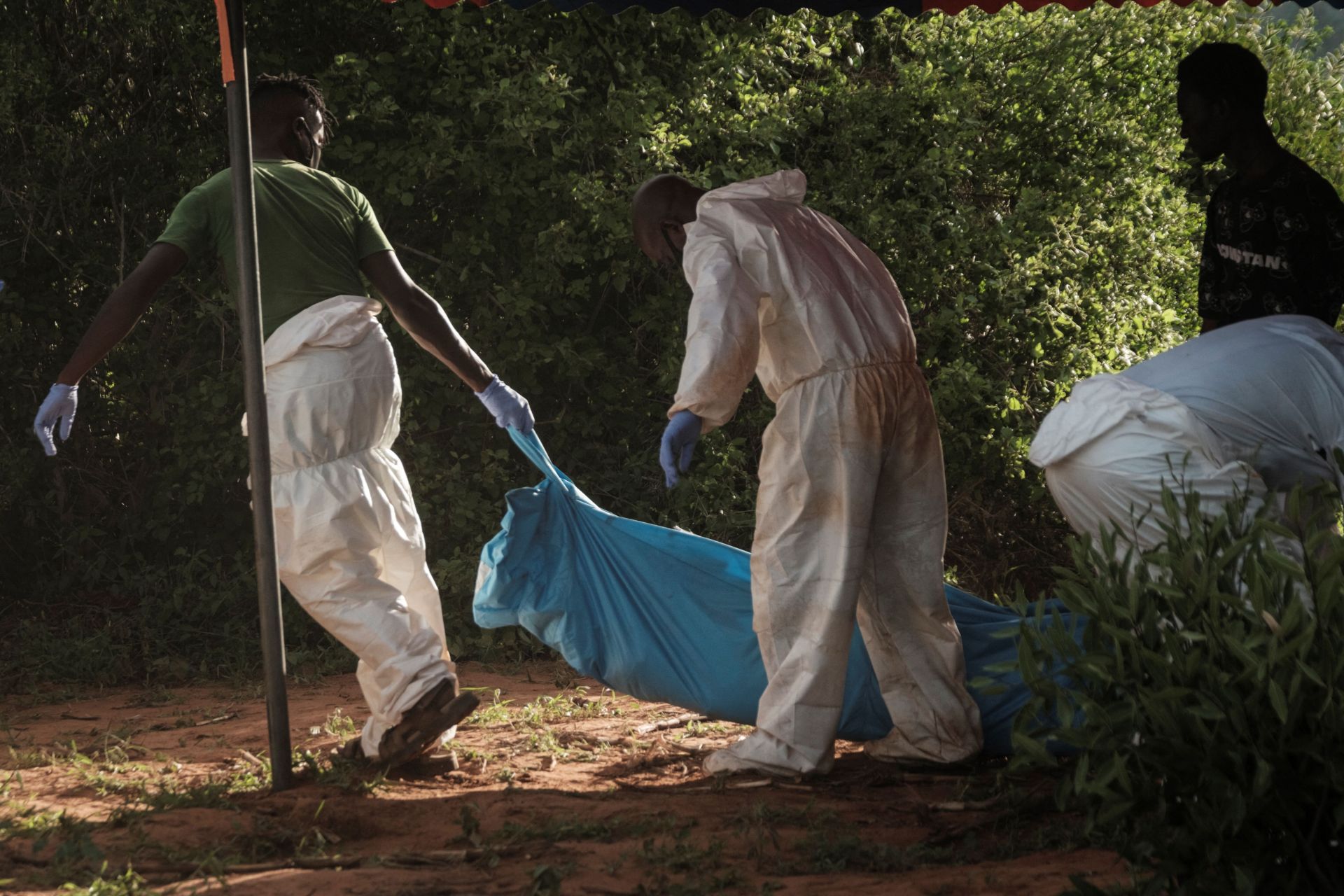
When they sold their homes all over the country and headed for Malindi, believers thought they were going to live a beautiful life of fellowship and communion with other believers, to make wonderful music as the righteous do in heaven, and pray, waiting for the Messiah to come and take them to Paradise. Instead they found the slowest, most painful death known to man, fear and suffering beyond measure.
An old woman kneels outside a mud-and-thatch cabin deep inside Shakahola Forest in Kilifi County. In her arms is an eight-year-old-child, weak and dying. The boy is dressed in new “special clothes”. Four strangers burst into the clearing, startling the old woman.
In the distance, a crowd is approaching and two of the strangers – members of the boy’s extended family – can make out the child’s mother and father in the group. They too are dressed in their best, as if for an occasion. They are also rattled by the strangers. They take to their heels and disappear into the bush. Two of the strangers, police officers from Langobaya Police Station, respond swiftly and snatch the boy from the old woman. Confused and scared, she too flees into the forest.
The boy is weak and can barely talk. The strangers give him glucose and some water and he appears to regain some strength.
“Where are your brothers?” they ask him.
“They went home to see Jesus,” the child answers, pointing at two fresh flat graves where his siblings are buried.
Two of the strangers are the boy’s cousins and the rescue party was organised by his grandfather. They got there just in time for this day, March 17, 2023, the designated day of his death. His younger brother, Seth, died the previous day; Imani, the lastborn, a day earlier.
“They have come for my wedding,” the child says of the crowd that has scattered.
‘Wedding’, in the language of Good Life Christian Church, is a celebration of a follower’s supposed reunion with Jesus Christ, achieved through fasting to death. The sect has a system, called maombi, or prayers, of fasting. It is also described as “kufunga bila kushuka”, fasting without relenting.
The rescued child was among the lucky few. Some 453 sect members are confirmed dead, among them 182 children, in one of Kenya’s worst mass casualty incidents.
Fifty mass graves are now being exhumed and more bodies are being found, though not in the same numbers as previously, which means the final death toll will be higher. Some starved from fasting, others were strangled or bludgeoned, according to government postmortem examination of the exhumed bodies.
The family believes Seth was suffocated by his mother. He was weak and suffering. She covered his mouth and nose until he died, they claim. Such fears are common among traumatised families who have lost loved ones, especially children. But the truth will only be established by the trial of sect members and leaders now going on in Malindi.
At some point, the cult members adopted a slightly different approach to maombi. Evah, whose full name is withheld to protect the identity of her children, lived with her two sons in what she termed ‘New Eden’.
She said during fasting, the family would stop cooking altogether and no one was allowed to eat or even take a sip of water. The entire family was to be ‘cleansed’ through fasting until they would all ‘ascend’ to meet Jesus. They had to fast until one of the children, usually the youngest, was on the verge of death. On that day, the family was expected to cook and everyone had to eat, except the weak one. Once the weakest died, the programme would be repeated for each child, then the mother and ultimately the father.
Eve and her children survived because they fasted only for a couple of days, then they broke the rules and ate. Eventually, she fled the forest, mobilised help and rescued her children. Eve was a practising Christian before she joined Good News and even though she was a fervent believer in its teachings, loved its leader and was deliriously happy in the forest – “I was happy here, I was free” – she said the earlier teachings of her church stopped her from going to the extent of killing her children.
“We were taught to fast for a few days, not to death,” she said.
Salama, 30, was in the forest with her husband and five children, the youngest of whom was born without medical attention in the hovels of Shakahola. Her fasting formula involved denying children food in pairs, starting with “hawa wa haraka haraka”, the very young who would “sleep” after only two days of fasting. After she gave birth, she attempted to fast her child in accordance with cult teachings. “I breastfed the newborn once, then put it on a fast for a day.
“The baby cried the whole night, non-stop. I didn’t have the heart to continue,” she said. The children being fasted were simply locked up in a room without food or water. The older ones probably understood the concept of dying to go and meet Jesus; the young ones did not. Their cries for help would have melted the heart of Lucifer himself.
“Mama twafa! Mama mbona unatuua!” (Mum we are dying! Mum why are you killing us) Salama’s children wailed until she fed them.
In the cult’s plan, children were to fast to death first, followed by the women and then the men. Some, however, did not wait; they fasted and died with their children.
There are many theories why children were chosen to die first. Pastor Titus [full name titles], who claims to have been the deputy of cult leader Paul Nthenge Makenzi – Makenzi maintains that Titus was “just a mshiriki (follower)” – said children were a distraction to the adults, whose fanatical purpose was to “condemn” their earthly, physical bodies (kuhukumu mwili) and release their spirits, to go and meet Jesus.
A child who was not cooperative and obedient – took water, ate, was noisy or hysterical – was dealt with firmly. “The father then has to step forward and play his role,” said Eva, with a meaningful glare.
Early responders from the local community claim small children whose parents did not have the stomach to see them through the fast to death, or were disobedient, were locked up in a house – a death pen – until they died one after the other. Older ones were tied to trees, fasting bays, in the heat of the coastal sun till death.
Fasting the children to death and celebrating their demise showed how far the followers of Good Life had travelled from the beliefs and practices of ordinary, mainstream Christianity. They lived in another reality where the death of a child was reason for joy and death was more desirable than life.
Staccato explosions of finality
Mzee Samuel Ngala, a farmer and merchant who supplied food to the sect settlement and might have been a member, observed wryly that were Makenzi allowed to speak to the parliamentary committee that was investigating the sect, he would have succeeded in converting quite a few of the MPs. Such is the respect for the preacher’s persuasive powers. The gift of oratory appears to run in the Makenzi clan. Paul and his brothers Mutinda and Mbatha are slight of build but with big booming voices and a stern manner of emphasis that is totally intolerant of contrary opinion. Makenzi, in his early life as a taxi driver, was never known to have seen anyone else’s point of view. It was his way or the highway. His sermons were staccato explosions of finality. To date, he speaks with the authority of God even when his logic is weak and the teaching against scripture. When he says “elimu si mpango wa mungu”, he does so with complete authority and anybody with a contrary view is likely to be dismissed as a deviant Babylonian.
If the gift of the gab runs in the Makenzi family, so does fibbing. The biography that the two brothers provided of their family is largely invented. They painted the picture of their father as a devout Christian – a church elder, assistant pastor and lay preacher – depending on the version – who donated land for the construction of the local chapel of the African Brotherhood Church.
And Paul is presented as the loving and forgiving son who had a tough relationship with his father while growing up. Makenzi senior may have given out land for the church, but it is also likely he died a Muslim.
And Paul did not even attend his father’s funeral. His youngest brother took reporters to a primary school he clearly did not attend; he claimed not to remember his teachers, classmates, or even his head teacher. Locals swore he never set foot in the school but could readily remember the older brothers.
The bodies of 425 followers, including 182 children, some too young to know anything about faith, lie in shipping crates in Malindi. Hundreds of others are probably still rotting in shallow mass graves in the bush. An unknown number of others are living like and with wild animals in the forests of Chakama while 31 are standing trial for murder and cruelty to children.
Some are hiding in plain sight, pretending to have fallen out with Makenzi and claiming they never went to the forest in the first place or that they never really believed their church’s teachings. Some even offer information and evidence against the cult, perhaps with the intention of avoiding arrest, prosecution and the stigma of what their cult is accused of doing.
In the beginning these were ordinary, everyday people – housewives, police officers, air hostesses, farmers, municipal workers, drivers – and their unlucky children. The accusations they face paint them as the most horrible, fanatical monsters.
If little knowledge is dangerous, Makenzi – like other street preachers without doctrinal training and who preach that elimu ni dini (education is a religion owned by Free Masons and the Illuminati) – is an atomic bomb, with a bust fuse.